A Day at Vercel Ship London
2026·06·18 · 4 min
I spent the day at Vercel Ship London. I left realising how much of the work that used to need a team (the ops, the infrastructure, the busywork) can now be handled by agents. Here's what stood out, from the talks to the people I ended up talking to between them.
Some Background
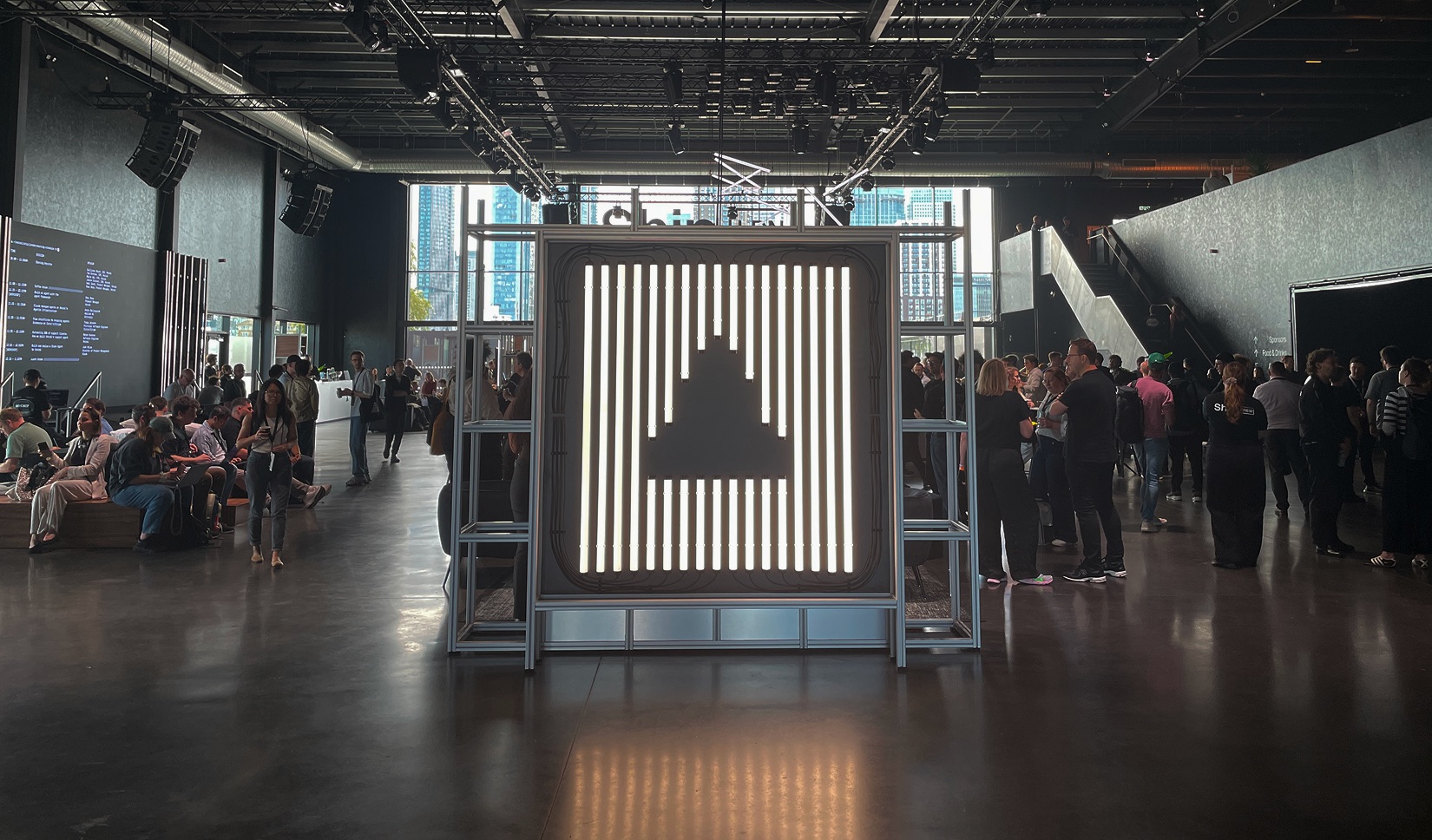
Ship is Vercel's annual conference, and this year it landed at Magazine London on the Greenwich Peninsula. The whole event centred on agentic infrastructure, which the keynote pitched as the platform's next natural step. The key value proposition is observability: every action an agent takes shows up next to your deployments, traced call by call, so you can see exactly what it did. Pretty important for software you're letting act on its own.
I went in as a fairly narrow Vercel user. I've used it for hosting, and I build most of my web apps with Next.js, but I'd never touched the rest of the stack. Though by the end of the day this felt less like a gap and more like a starting point.
The Talks
The main stage moved fast. Guillermo Rauch opened, the product team ran through announcements. Throughout the day there were a number of interesting talks. Alex Holt from ElevenLabs built up a real-time voice agent on Vercel's AI SDK, and Malavika Balachandran Tadeusz from Vercel gave an insightful presentation on self-driving applications.
The big announcement was Eve, an open-source framework where an agent is just a directory of files, pitched as "Next.js for agents". It's a clever idea and worth a look, but it's not what I came away thinking about most.
The bit that surprised me more was how much Vercel leans on this stuff internally. They run over a hundred agents in production, each one having a measurable impact on their operations. Their most-used internal tool is a data analyst agent that answers more than 30,000 questions a month in Slack, scoped so it can only ever show you data you already have access to. A support agent resolves 92% of its tickets on its own and escalates the rest, and there's even a routing agent whose whole job is to delegate incoming tasks to appropriate agents.
The one that really stuck with me, though, was their sales agent. It runs their best rep's playbook around the clock, working every new lead the moment it lands and following up on its own so none go cold. The number they put on it was the impressive part: it costs about $5,000 a year to run, returns 32 times that, and a single engineer maintains it part-time. The age of billion-dollar solo startups might well be close.
The day closed with a fireside chat between Guillermo Rauch and Harry Stebbings of 20VC, a change of pace from the product talks, more about founders and how you carve out a voice now that anyone can ship software. The throughline was a real bullishness about building in Europe right now, and as someone starting out here, I'm fully on board.
The Conversations
What I didn't expect was how much I'd get out of just chatting with people between the talks.
I spent a good chunk of the day at the sponsor booths, and the engineers manning them were genuinely good company. Two stuck with me. One was with someone from Auth0, which ended up being a conversation that's shaped how I want to move forward with something I'm currently building. The other was with someone from Cursor, and I couldn't not congratulate him, given SpaceX had announced it was buying them for $60 billion quite literally the day before.
That's the part of a conference you can't get from a livestream, and it's the part I'd tell anyone on the fence about going to something like this to optimise for. Show up early and visit the booths when they're quiet.
What I'm Taking Away
The two things I keep coming back to aren't necessarily the agents themselves but the underlying infrastructure.
The AI SDK is Vercel's open-source TypeScript toolkit for calling models, streaming responses, and defining tools the model can use. It's TypeScript and it fits into the Next.js projects I'm already building, so there's almost no reason not to try it.
The AI Gateway is the other one. It's a single endpoint that routes to hundreds of models from different providers, with fallbacks, budgets, and observability built in, so you don't wire up each provider separately. You pass a model string straight to the AI SDK and it routes for you. Up to now I've mostly run models through Cloudflare Workers AI, which has been great for staying on the edge but is still somewhat limited by which models are available.
Worth It?
Yes, and not for the reason I'd have guessed going in. I expected to leave with a head full of product announcements, and I did. What I didn't expect was just how much I'd enjoy conversations between the talks. Worth the trip, and I came home with all the merch to prove it.